Saturday, November 21, 2009

Boy, are my arms not tired.

See this plane. See how it's wheels are on the ground? That's not a good thing. For me, at least.
That's KU's Chris Allen at the door. For the last month-plus the electrical engineering professor has headed a team flying on the NASA DC-8 that's been mapping ice on and around Antarctica. They've packed the plane with leading-edge radars capable of a dizzying array of measurements that can penetrate kilometers deep into the surface. That lets them figure out how high the ice is, and how deep it is -- sorting out where the ice stops and the ground begins.
Because the bevy of sensors needs clear skies to make its measurements, clear weather has been key. And they've been lucky, even adding flights to their mission because the gods were kind.
But final extra flights when I arrived in Punta Arenas, Chile, this week got postponed once, twice and finally, this morning scrubbed for good. So my hopes for flying over the continent were dashed.
The various logisitic and scientific crews weren't terribly bummed. They're worn out and now they can get a head start on packing up for the ride home.
Posted by Picasa

Friday, November 20, 2009

Everything is so different here


I've been accused of not being amenable to local cuisine, or fresh cuisine of any sort. But I offer this as Exhibit A in evidence of my daring palate. You see here a container not of quotidian, stateside sour-cream-and-onion Pringles, but a quite Latin American package of Kryspos -- that's Kryzpo with a "K." If you investigate I think you'll find not a single k in the entire word "Pringles."
And what's up with the Dreams Casino in Punta Arenas. Sure, it's on the (quite frigid) beach, but there appears to be no moat of water around the thing. The people here must be loco.

Posted by Picasa

It's always a campaign year -- or is that happy hour? -- somewhere

While the U.S. waits impatiently for, or works desperately against, hope and change, Chile is approaching the eve of its presidential election.
The incumbent, Michelle Bachelet, had a rough start but is leaving office next year as a rare president with rising popularity ratings.

So now we have opposition candidate Sebastian Pinera pitted against former president Eduardo Frei in the December 13 voting. Pinera is ahead in polling with37 percent support, followed by Frei with 28 percent. Independent candidate Marco Enriquez-Ominami is playing the Ross Perot role and is polling at 17 percent.
Banners and posters are ubiquitous in Punta Arenas and campaign appearances dominate local TV.  
Strikes are pretty regular here, and have ramped up in anticipation of the election. A few-hours strike of meteorologists played a small role in determining whether a flight over Antarctica I'd like to tag along with might be delayed. The weather guys came back to work, but the flight was scrubbed because of a cloud bank moving toward the Antarctic peninsula.

Thursday, November 19, 2009

The deep south

We are in MuttonWorld.

Punta Arenas sits by Strait of Magellan, marking where Pacific waters become Atlantic. It's the southernmost city of any size (about 116,000) in the world. Think cold and windy, without a whole lot of winter sunshine.
The Spainiard José de los Santos Mardones established the place in southern Patagonia in 1849 and it became a signficant port of call and coal depot until the Panama Canal created the shortcut that meant shipping routes didn't have to snake below South America. But while it was big, it was also a popular gathering spot for spies keeping eyes out for what was going where.
Now it's about sheep and oil, drawn from the Tierra del Fuego oil fields.
Chile claims a sliver of Anarctica that runs clear to the South Pole. In fact, there's a monumnet south of Punta Arenas -- which lies at the south end of what the rest of the world recognizes as Chile -- that marks the supposed center of Chile.

South for the (Austral) summer


I'd forgotten how much Spanish I'd forgotten.
Still, there's a special kick to navigating a foreign city on your own. (Last night I escaped from the torture that is modern air travel. About 36 hours of cramped seats and crowded airports. Almost makes you yearn for the days of scurvy and storms that would have brought you to the Strait of Magellan by steam and sail a few generations ago.)
Anyway, like almost any place I've been, locals are surprisingly accommodating of unilingual Americans. Punta Arenas is a friendly port city that makes a go off of shipping, sheep and scientists. Lots of wool and fleece and glacier glasses. I arrived to weather I had left behind: soggy and about 15 degrees above freezing. I couldn't see the sun, but it appeared to set very late.
I come courtesy of the Marine Biological Laboratory which has put National Science Foundation bucks to use in a science writing fellowship that will take me and two other journalists to Palmer Station on the Antarctic peninsula. My main patron, of course, is The Kansas City Star, which has sprung me free for a little over a month and agreed to pick up the cost of sending me south a few days early in hopes of tagging along on a NASA DC-8 flight over the last continent. (That's still iffy. Maybe on Saturday if the skies clear.)
And most significantly, I'm here with the blessing of a family that's let me miss Thanksgiving and a very special birthday in pursuit of a frigid wanderlust.
Picked out a bag of loaner polar clothing at Raytheon's port-side warehouse this morning. (Apparently summers in Antarctica are cooler than in the Midwest.) I'd show you a picture of all the gear, includes something called a red yazoo cap that looks like it sounds, but it's already been  set aside for storage on the ship that will tow me farther south. They actually had comfy boots that fit my oversized feet. But, alas, no gloves large enough for a Sasquatch. (Luckily, I brought my own army surplus gloves and overmitts.)
If weather clears over Antarctica, I'll fly on a NASA ice-measuring plane over the continent tomorrow night. Weather and a strike at the airport have that trip in jeopardy for the moment. If that flight scrubs, maybe Saturday -- or not at all.

Give the "Boss" a go-cup

For Hemingway fanatics, it's a special bar in Paris or Key West. For me, the mecca of bars is here in Punta Arenas. The Shackleton Bar is tucked in the back of the Hotel Jose Nogueira and is said to serve a nifty version of the local specialty. (The pisco sour is sort of a Chilean margarita, sans salt.)
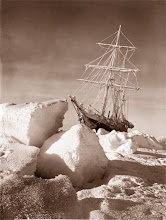
Ernest Shackleton, known by those in his famously failed expeditions as the Boss, stayed at the hotel, in those days owned by the epynomous Nogueira, while making repeated attempts to rescue the bulk of his crew when they were stranded on Elephant Island. One legend has him firing a gunshot into the roof of the bar when it was time to round up sailors for a rescue mission.
Today the walls are adorned with a series of paintings depicting the trevail and ultimate rescue of the Endurance crew.
Now, excuse me while I go down a cold one at the Boss' bar.
Posted by Picasa

Is it getting stuffy on this planet?


Not had any gloomy news on temperature and carbon build-up lately? Well, it's always coming.
The Global Carbon Project tells us earlier this week that a six degree Celsius
temperature rise by the end of the century is virtually inevitable. 


In the journal Nature Geoscience, a team of 31 researchers say a spike this decade of carbon emissions suggests a runaway train effect in the buildup of greenhouse gases. We posted earlier here news that the planet might be better at soaking up carbon, the new results suggests the Earth isn't as absorbent as we might like.

Monday, November 16, 2009

On the rocks


A number of witty friends suggest this is what's drawing me south, but I'm more about this.

Wednesday, November 11, 2009

Earth, like a dorky sweatband, soaks it up


A Brit's recent study of ice samples finds that the Earth has a surprising ability to absorb the increases in carbon dioxide in the air.
Although the rate at which we belch CO2 into the atmosphere has increased almost 18-fold since 1850, ice samples taken from Antarctica suggest the planet has soaked up almost half the carbon added to the mix by the activity of man. (Probably no small amount of it created in the manufacture of monstrous things like the one strapped to this guy's noggin.)
It could be a rosy finding, if it holds up, because conventional wisdom was that the Earth's ability to absorb CO2 would decrease as it became saturated.

Tuesday, November 10, 2009

Warming = less ice = more plankton = CO2 storage = less warming?

Just preliminary evidence here, but the British Antarctic Survey has found that the way melting ice allows more sunlight to shine in the ocean spurs significant blooms of tiny marine creatures. Those phytoplankton, in turn, eventually die and sink to the ocean bottom, taking carbon with them.
That means a symptom brought on by greenhouse gases, the melting of the ice, could spur a phenomenon that reduces the levels of those same greenhouse gases in the atmosphere.
Bad news: it doesn't look like the effect is anywhere nearly dramatic enough to offset the overall buildup of greenhouse gases.

Monday, November 9, 2009

New meaning to life list


`God save thee, ancient Mariner,
From the fiends that plague thee thus! -
Why look'st thou so?' -"With my crossbow
I shot the Albatross." -- Rime of the Ancient Mariner.

Turns out fish hooks work better (or is it worse?) than crossbows.
The top six species of sea birds at risk of extinction in the Atlantic hail from the albatross family. The British Antarctic Survey on South Georgia has found the number of those big birds flying today is just half the population of the early 1960s.
Your fish sticks might be the problem. In diving for their own seafood, an albatross is vulnerable to getting snagging by commercial fishing equipment -- either on hooks or in nets.
Now the Royal Society for the Protection of Birds and Birdlife International are calling for a treaty monitoring panel to impose new rules on fishing to protect the albatross.
But will using albatross-safe fishing methods be more costly, less fuel efficient, more damaging to other species?
In any event, it's long been considered bad luck to kill one of the birds. Just ask the ancient mariner.
'Is it he?' quoth one, 'Is this the man?
By him who died on cross,
With his cruel bow he laid full low
The harmless Albatross.


Wednesday, November 4, 2009

Let's hope CO2 ain't all that

The last time carbon dioxide levels were as high as they are today was, well, quite a long time ago.
Something like 15 million years ago. That's right, even before disco.
And the world was a much different place. Global temperatures were 5 to 10 degrees higher and sea levels were 75 to 20 feet higher.
How do we know? you ask.
It used to be we only knew about atmospheric levels going back about 800,000 years -- a blink of an eye in geographic time -- by studying bubbles of air trapped in long-frozen Antarctic ice.
Now comes the very clever Aradna Tripati, who has peered back further in time by looking at sea shells.
Specifically, she's charted the ratio of boron to calcium in the shells to figure out what the atmosphere was like when they were formed. That time travels a good 20 million years.

Melting, just not as fast as we thought

Good, but not great, news on the rate at which the West Antarctic (think western hemisphere -- it's confusing when you get down there) Ice Shelf is melting.
It is melting. And the debate about whether your Buick is responsible will go on. But tracking ice movements against bedrock suggests that previous estimates about the trimming of the ice shelf were overstated.
That said, the researchers say that ice is still melting.
"West Antarctica is still losing significant amounts of ice, the loss appears to be slightly slower than some recent estimates," said Ian Dalziel, a researcher with the West Antarctic GPS Network, said in a press release. "So the take home message is that Antarctica is contributing to rising sea levels. It is the rate that is unclear."

Tuesday, October 20, 2009

Calmest place on the planet, needs a Starbucks


You thought it was any room where that your mother-in-law wasn't in.
Sciences begs to disagree.
Turns out the calmest place on earth is a few hundred miles from the South Pole, so-called Ridge A. Things are so calm there, even the stars don't dare twinkle.
Based on studies of weather patterns, satellite data viewed from an astronomers point of view, a team of U.S. and Australian scientists have settled on the spot as the most mellow spot on Earth.
It's 13,300 feet above sea level and sits at the head of three humongous glaciers -- each muscling out over land the size of western Europe.
Calm is not paradise. At 100 times drier than the Sahara and with an average winter temperature of -94 degrees farenheit, it's the coldest and driest place on the planet.
Because the calm extends into space, scientists are noodling out the best way to plant a telescope there. If they succeed, the images could rival those of the Hubble space telescope.